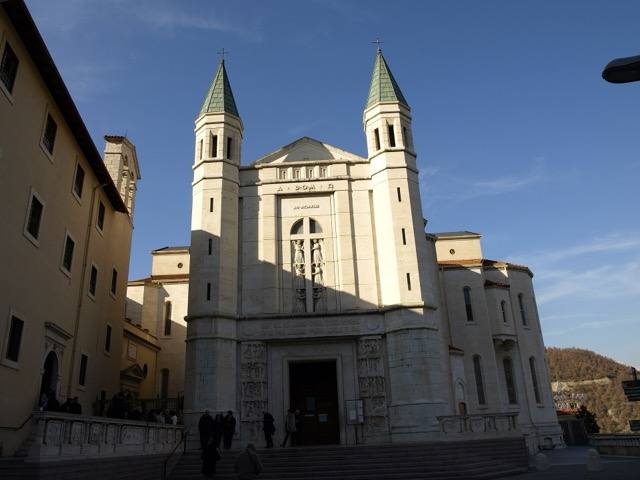

Pilgrim's guide
Assisi - Basilica of St Francis - pilgrim's guide
Photos: Berthold Werner · Public domain
The Basilica of St Francis in Assisi holds the tomb of the Poverello and some of the most beautiful frescoes in Europe. This guide is for those who want to come as pilgrims: to pray at the tomb, walk the streets of the saint's town and understand why Assisi moves people so deeply.
Machine-translated guide.
Why go
Assisi is a town where everything speaks of Francis: his family home, the churches where he prayed, the hermitage on the mountainside and finally the basilica with his tomb. Pilgrims come here not for the monuments but for the simplicity of the Gospel, which Francis lived so radically that he still attracts people from all over the world, including non-believers.
2026 is an exceptional year. It marks 800 years since the saint's death, and for the occasion the Apostolic Penitentiary has proclaimed a special Franciscan Jubilee Year, running until 10 January 2027, with the possibility of gaining a plenary indulgence under the usual conditions. It is a good moment to plan a pilgrimage.
A short history
Francis died in 1226 and was canonised just two years later. The day after the canonisation, on 17 July 1228, Pope Gregory IX blessed the hill on which the basilica was to be built. The design is attributed to Brother Elias. In 1230 the saint's body was laid in a crypt beneath the high altar of the lower church, and the whole building was consecrated in 1253. Beside it rose the Sacro Convento, the great friary of the Conventual Friars Minor.
For centuries the tomb was hidden and was rediscovered only in December 1818, after which a crypt accessible to the faithful was created. The lower church is decorated with frescoes by Cimabue, Simone Martini and Pietro Lorenzetti, among others, and the upper church with the famous cycle of scenes from the life of Francis, traditionally attributed to Giotto. In 1997 an earthquake destroyed part of the vault of the upper church, killing four people; the vault was rebuilt. In 2000 the basilica was inscribed, together with other Franciscan sites, on the UNESCO list. In late February and early March 2026, for the first time in history, the saint's body was exposed publicly for veneration.
Getting there
Many pilgrims fly to Rome and continue to Umbria by train or coach. Closer to Assisi is Umbria International Airport near Perugia, about 12 km from the town; check which routes it currently serves. Parish groups often combine Assisi with Rome or Loreto on a single coach itinerary.
- by train: Assisi station lies on the plain at Santa Maria degli Angeli, approx. 3 km from the old town, on the Florence - Perugia - Foligno line; from Rome you usually change at Foligno
- by bus: a bus runs from outside the station up to the basilica, taking about 10 minutes
- from the airport near Perugia: bus or taxi
- by car: on the E45 (Assisi exit), coming from the A1 or A14; traffic restrictions apply in the centre, so cars are left in car parks below the walls
When to come
Assisi is beautiful at any time of year, but in spring and summer and at weekends it can be very crowded. It is calmest on weekdays, early in the morning. The Franciscan Jubilee Year runs until 10 January 2027, so expect more groups than usual.
- 4 October - solemnity of St Francis, the town's main feast and that of the patron of Italy
- until 10 January 2027 - Jubilee Year for the 800th anniversary of the saint's death
- spring and autumn - pleasant temperatures for walking the steep streets
- Friday and Saturday evenings - the crypt is additionally open for personal prayer, details on the basilica website
What to see and experience
- the crypt with the tomb of St Francis beneath the lower church - a place of silence and prayer
- the lower church with frescoes by Cimabue, Simone Martini and Pietro Lorenzetti
- the upper church with the cycle of scenes from the life of Francis
- the basilica's Treasury Museum
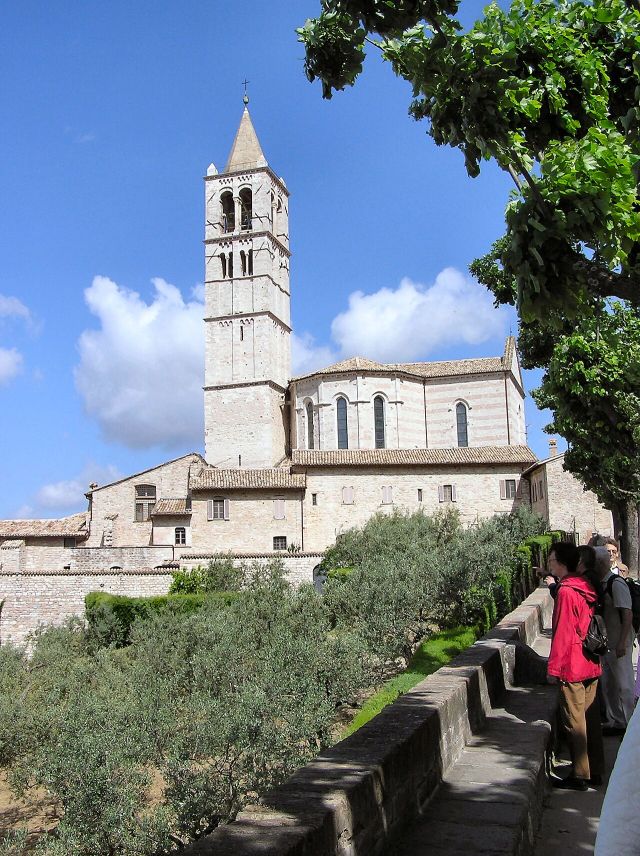
- the Basilica of St Clare with the saint's tomb
- the Sanctuary of the Spoliation at the church of Santa Maria Maggiore, where St Carlo Acutis rests
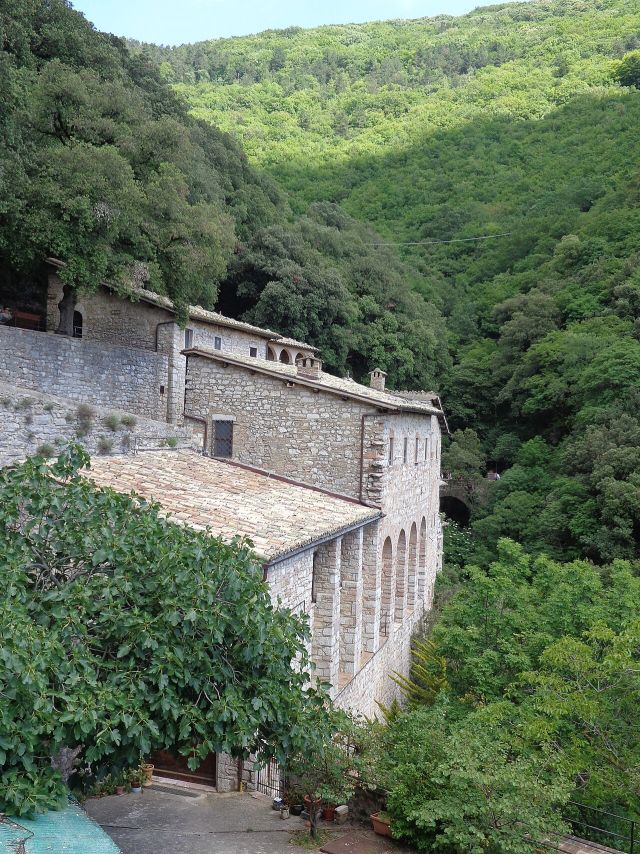
- the Carceri Hermitage on the slopes of Monte Subasio
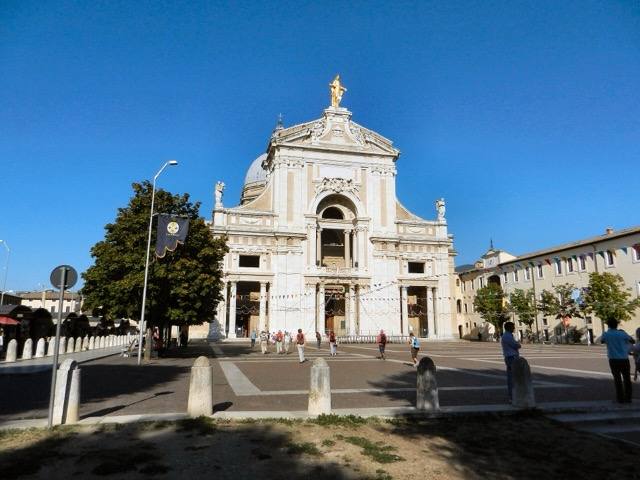
- the Basilica of St Mary of the Angels on the plain, with the Portiuncula chapel
Practical information
- dress: modest, with shoulders and knees covered
- silence is required in the crypt and the churches; no photographs at the tomb
- accessibility: the lower church is accessible from the level of the square, steps lead to the upper church, and you go down stairs to the crypt
- groups can book a Mass or a visit through the basilica's official booking system
- the Testimonium for walking pilgrims is issued by the Statio Peregrinorum at the Sacro Convento
- opening times of the churches and crypt, and Mass times: check the basilica website
Accommodation and food
In Assisi and Santa Maria degli Angeli there are many religious houses that welcome pilgrims, as well as guesthouses and hotels. Staying in the old town lets you see Assisi in the evening and at dawn, when the streets are empty. On the plain near the station it is usually cheaper and easier to reach. Local Umbrian cooking is simple and filling, and small shops selling bread and cheese are enough for a pilgrim's meal.
Tips from pilgrims
- go to the crypt first thing on a weekday morning, before the coaches arrive - the silence at the tomb is then deeply moving
- bring comfortable shoes, as the streets are steep, stone-paved and slippery after rain
- take a warmer layer, as the crypt and lower church can be chilly
- do not try to see everything in one day; two days let you combine the basilica with the Carceri Hermitage and the Portiuncula
- begin or end the day at Mass in the lower church - it is a different experience from sightseeing
- it is worth walking up to the Carceri Hermitage, but it is a demanding uphill climb
On foot and on the trail
Assisi is the destination of the Way of St Francis (Via di Francesco). The northern route leads from Florence or Rimini via La Verna, among other places, and the southern route from Rome. Take the official credential for the journey, which you order in advance through the office of the Diocese of Gubbio. Anyone who has walked at least the last 100 km or cycled 200 km can collect the Testimonium Viae Francisci on arrival at the Statio Peregrinorum pilgrim office at the Sacro Convento.
Assisi is also the starting point of the Via Lauretana, which links the town of Francis with the shrine of the Holy House in Loreto.
Frequently asked questions
Where is the tomb of St Francis?
In the crypt beneath the lower church of the basilica. You go down to it from the lower church. It is a place of prayer, so silence is required and photography is not allowed.
How do I get to Assisi from Rome?
The simplest way is by train to Assisi station, usually changing at Foligno, then by bus from the station up to the basilica. Groups most often arrive by coach.
Can an indulgence be gained in Assisi in 2026?
Yes. For the 800th anniversary of the death of St Francis a Jubilee Year has been proclaimed, running until 10 January 2027. A plenary indulgence can be gained under the usual conditions: confession, Holy Communion and prayer for the intentions of the Holy Father.
How much time do I need for Assisi?
A few hours are enough for the basilica alone, but to also see the Basilica of St Clare, the Carlo Acutis shrine, the Carceri Hermitage and the Portiuncula, it is best to plan at least two days.
Where is Carlo Acutis buried?
In Assisi, in the Sanctuary of the Spoliation at the church of Santa Maria Maggiore, a few minutes' walk from the centre. His body has rested there since 2019.
How do I receive the Testimonium after walking the Way of St Francis?
You need a stamped credential and must have walked at least the last 100 km or cycled 200 km. The Testimonium is collected in person at the Statio Peregrinorum at the Sacro Convento.