
Pilgrim's guide
San Giovanni Rotondo - Shrine of St Padre Pio - pilgrim's guide
Photos: Icelandtourist12 · CC BY-SA 4.0
In San Giovanni Rotondo, on the slopes of the Gargano peninsula, St Padre Pio lived and heard confessions for more than half a century. This guide is for pilgrims who want to come to his tomb, go to confession and get to know the places connected with his life.
Machine-translated guide.
Why go
San Giovanni Rotondo is a place people come to with something specific on their heart. Padre Pio spent his whole life in prayer, celebrating Mass and hearing the confessions of great crowds. Pilgrims come here to pray quietly beside his body, to go to confession and to leave their intentions, often for the sick. The hospital he founded next to the friary, the Home for the Relief of Suffering, carries on in the same spirit.
The place also has a special link with St John Paul II. In 1947 a young priest, Karol Wojtyła, visited Padre Pio, and in 1962, by then a bishop, he wrote asking him to pray for the gravely ill Wanda Półtawska, who soon recovered. It was John Paul II who later declared Padre Pio blessed and then a saint.
A short history
Francesco Forgione was born on 25 May 1887 in Pietrelcina, joined the Capuchins and took the name Pio. He was ordained a priest in 1910, and in September 1916 he came to the friary of Our Lady of Grace in San Giovanni Rotondo, where he stayed for the rest of his life. On 20 September 1918 visible stigmata appeared on his body. For a time the Church authorities restricted his public ministry; the ban on celebrating public Mass was lifted in 1933.
In 1956 the Home for the Relief of Suffering hospital opened, built from donors' offerings. Padre Pio died on 23 September 1968. John Paul II beatified him on 2 May 1999 and canonised him on 16 June 2002. In 2004 the large new church of St Pio, designed by Renzo Piano, was consecrated, and on 19 April 2010 the saint's body was moved to the crypt in its lower level.
Getting there
San Giovanni Rotondo lies in Apulia, in the province of Foggia. Most international visitors fly into Bari, whose airport is named after Karol Wojtyła and is about 160 km away, or into Rome or Naples and continue by train to Foggia. Many parishes also organise coach pilgrimages combining San Giovanni Rotondo with Monte Sant'Angelo, Rome and Pompeii.
- by train: to Foggia station, from where regional buses run to San Giovanni Rotondo; tickets can be bought at the station
- by air: the nearest airport is Foggia, about 40 km away, but Bari airport is used more often
- by car: on the A14 motorway (from the north, exit San Severo; from the south, exit Foggia) or the A16, then on the road towards Manfredonia and San Giovanni Rotondo
- by long-distance bus: direct services run from some Italian cities; check current timetables with the operators
When to go
The shrine welcomes pilgrims all year round. The busiest times are summer and September, around the anniversary of the saint's death. Winter is quieter, but up on the Gargano it can be cold and windy.
- 23 September - liturgical memorial of St Pio and anniversary of his death, the largest influx of pilgrims
- 20 September - anniversary of the stigmata
- 25 May - anniversary of the saint's birth
- weekdays outside the season - the best time for quiet prayer at the tomb
What to see and experience
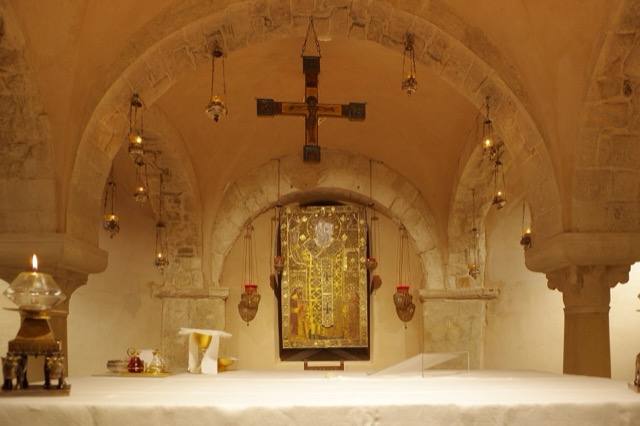
- the crypt in the lower level of the church of St Pio, with the saint's body, decorated with golden mosaics
- the church of St Pio designed by Renzo Piano, which can hold thousands of the faithful
- the shrine of Our Lady of Grace, where Padre Pio prayed and heard confessions
- the old little church with the wooden crucifix before which, according to tradition, he received the stigmata
- the Capuchin friary with places connected with the saint's daily life
- the monumental Way of the Cross on the hillside above the shrine
- the Home for the Relief of Suffering hospital - a visible fruit of his work of mercy
Practical information
- dress: modest, with shoulders and knees covered, as at any shrine
- confession is one of the most important parts of the pilgrimage; places and times are given on the shrine's website
- the shrine's Pilgrimage Office takes group bookings and arranges a welcome liturgy and guided visits
- the shrine's website is available in several languages
- prayer intentions can be left on site or sent through the shrine's website
- the saint's body is occasionally moved for a short time for special celebrations; check announcements before you travel
- opening times and Masses: check the shrine's website
Accommodation and food
San Giovanni Rotondo lives from pilgrims, so there is plenty of accommodation: hotels, guesthouses and religious houses, many of them set up for groups. Most are within a short walk of the shrine. Outside the peak season it is easy to find a room without booking far ahead. Gargano cooking is known for simple dishes with olive oil, vegetables and local bread.
Tips from pilgrims
- plan at least one full day - confession, Mass, the crypt and the Way of the Cross all take time
- the best time to go down to the crypt is early in the morning or in the evening, when the groups have left
- prepare for confession in advance, as queues at the confessionals can be long on peak days
- walk the Way of the Cross on the hill in the cooler part of the day and in comfortable shoes
- many pilgrims combine the visit with Monte Sant'Angelo, the shrine of St Michael the Archangel, a short drive away
- it is easy to lose your group in the new church; agree on a meeting point by the exit
Frequently asked questions
Where does the body of St Padre Pio rest?
In the crypt in the lower level of the church of St Pio in San Giovanni Rotondo, where it was moved in 2010. Before that it rested in the crypt of the shrine of Our Lady of Grace.
How do I get to San Giovanni Rotondo?
Most often by flying to Bari and continuing by bus or car. You can also fly to Rome or Naples and take the train to Foggia, from where buses run to San Giovanni Rotondo.
Can I go to confession in my own language?
The shrine welcomes pilgrims from all over the world and confession in various languages is often possible, but it is worth checking in advance whether confessors speaking your language will be available. Groups travelling with a priest usually have their own confessor.
When is the feast of Padre Pio?
23 September, the anniversary of his death in 1968. It is the day of the greatest celebrations in San Giovanni Rotondo.
What was Padre Pio's connection with John Paul II?
Karol Wojtyła visited him in 1947, and in 1962 asked him to pray for Wanda Półtawska, who recovered. As Pope he beatified him in 1999 and canonised him in 2002.