Shrine guides
Pilgrimage to Medjugorje: guide, Church position, getting there
Published October 21, 2026 · 11 minute read
A reliable guide to Medjugorje: what the note "La Regina della Pace" says, how to pray on Podbrdo and Križevac, how to get there and what to combine it with.
Machine translation of an article written in Polish.
For many people, a pilgrimage to Medjugorje is one of the most important journeys of their lives. This small town in Herzegovina draws people looking for silence, prayer, confession and a renewal of faith. In this guide we explain calmly and accurately what the Church's position is, what to see there, how to get there and how to prepare for the journey so that it is safe and well lived.
You will not find promises of extraordinary signs or sensationalism here. You will find practical tips to help you live this time in a spirit of prayer, with respect for the place, the local people and other pilgrims. You will find the place page with a map at Medjugorje in the Bratnio catalogue.
The Church's position on Medjugorje
Since 1981 a group of people from the parish of Medjugorje have spoken of apparitions of Our Lady, called there the Queen of Peace. For decades the matter was examined by successive commissions, and the Holy See remained cautious. In 2019 Pope Francis allowed official pilgrimages to Medjugorje to be organised by parishes and dioceses, with the proviso that this did not amount to a judgement on the phenomena themselves.
In September 2024 the Dicastery for the Doctrine of the Faith, with the approval of Pope Francis, published the note "La Regina della Pace" (The Queen of Peace). The document grants a nihil obstat to the spiritual experience associated with Medjugorje. This means a positive assessment of its spiritual fruits, such as conversions, a return to the sacraments, prayer and vocations, as well as permission for public worship and pilgrimages.
At the same time, the note clearly states that it is not a declaration of the supernatural character of the alleged apparitions. The faithful may draw spiritual good from this place, but they are not obliged to believe in the apparitions. The document also encourages caution regarding some of the messages that have been passed on, and calls for unity with the local Church. You will find the full text and statements of the Holy See on the official website vatican.va.
For the pilgrim, this leads to a simple guideline: Medjugorje is a place of prayer that the Church recognises as spiritually fruitful. The heart of the pilgrimage is the Eucharist, confession, the Rosary and adoration, not the expectation of extraordinary phenomena.
Saint James' Church, the heart of the parish
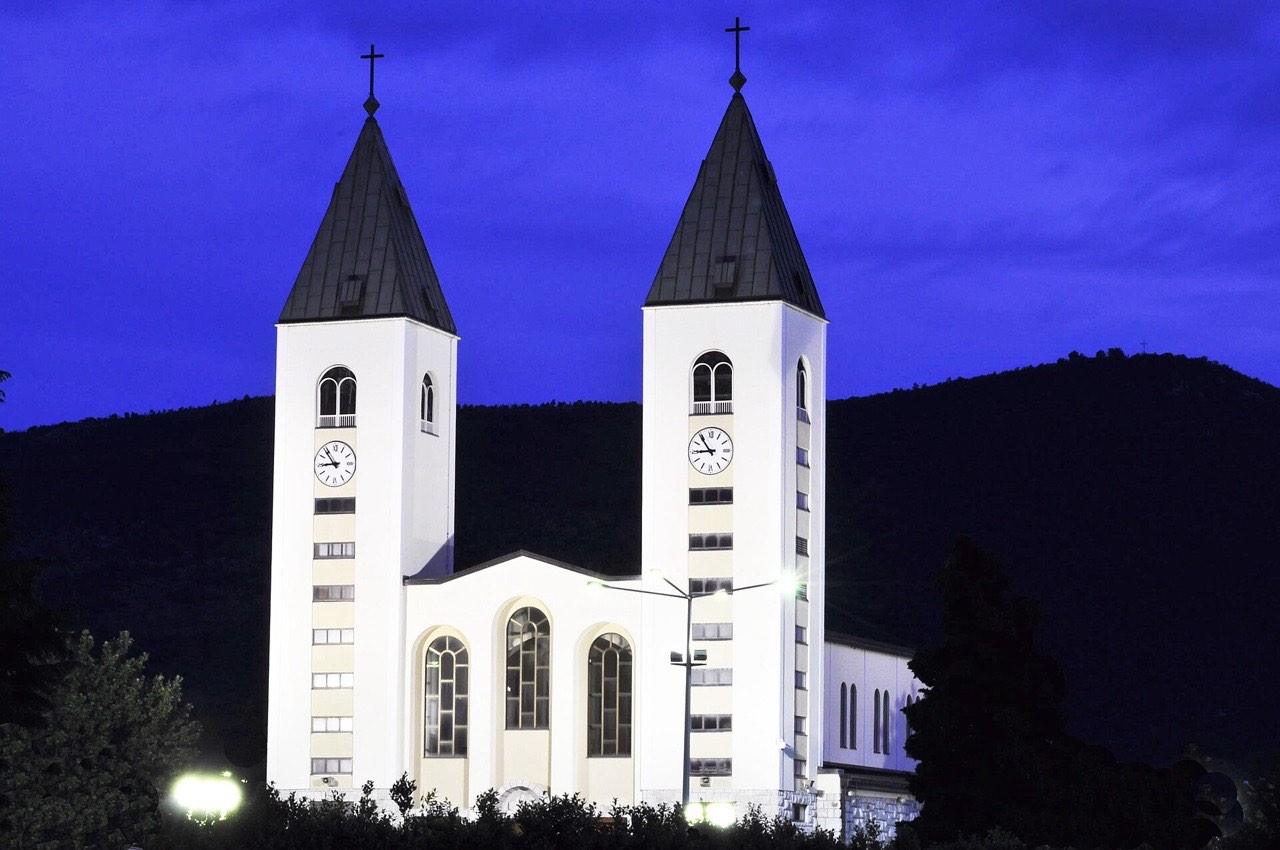
The spiritual centre of Medjugorje is the parish church of Saint James the Apostle, patron of pilgrims. For many people this immediately brings to mind the road to Santiago de Compostela. The parish is in the care of the Franciscans of the Herzegovinian province, and all religious life remains in unity with the local bishop of the Diocese of Mostar-Duvno.
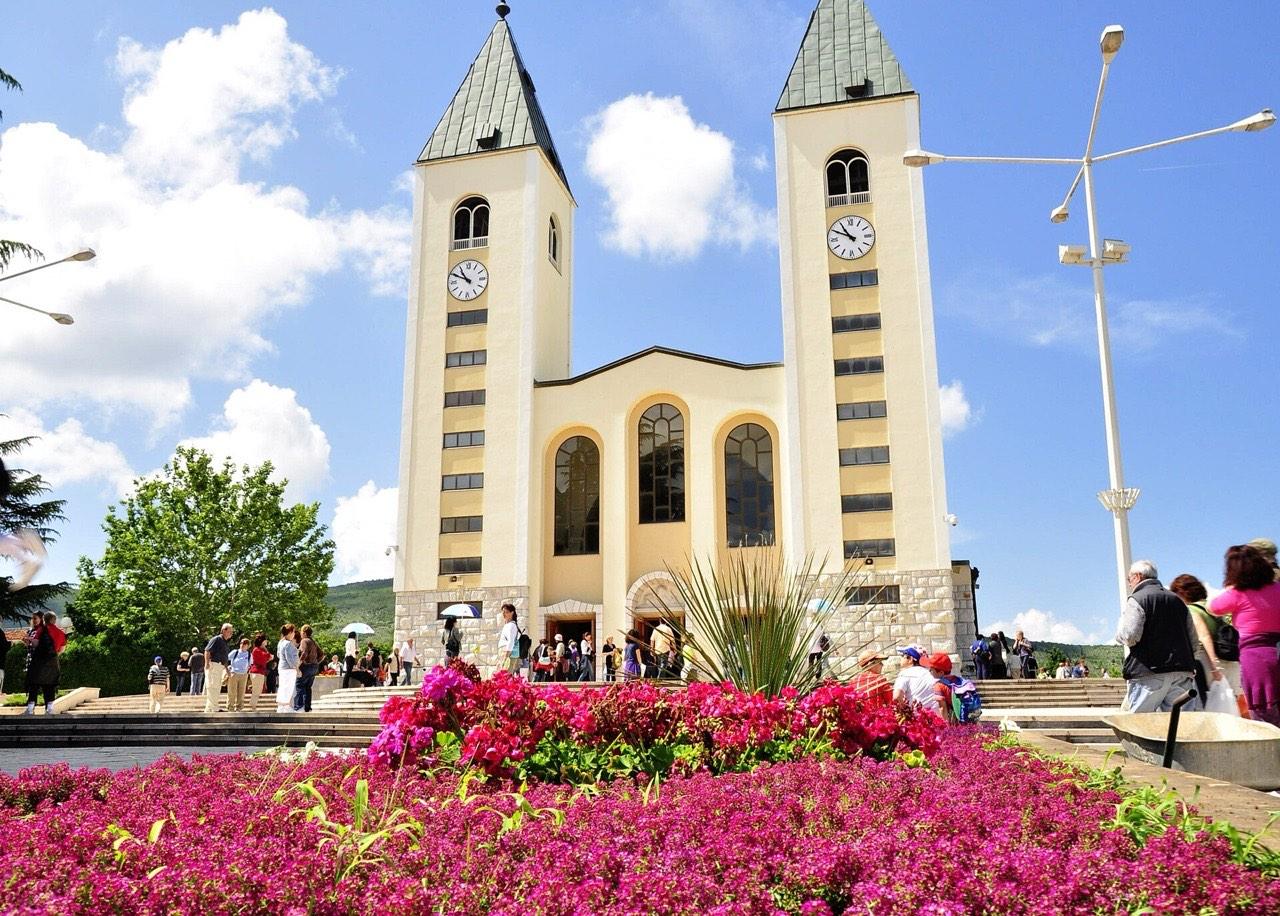
Around the church there is a large open area with an outdoor altar, where Masses and services are celebrated when there are many faithful. During the day Masses are celebrated in various languages. It is best to check the current prayer programme on the parish's official website medjugorje.hr or at the information point on site, as it changes with the seasons.
The evening prayer programme usually includes the Rosary, Mass and adoration. Many people say that these evenings, the shared prayer of thousands of people from different countries in silence before the Blessed Sacrament, are the most powerful experience of the whole trip.
Confession and prayer in Medjugorje
Medjugorje is sometimes called "the confessional of the world". There are many confessionals by the church, and priests hear confessions in many languages. At busy times the queues can be long, so it is worth planning confession for a quieter time of day and not leaving it until the last evening.
A few practical tips on prayer:
- bring a rosary and a small prayer book, or save your favourite prayers on your phone;
- plan at least a quarter of an hour of silence each day outside your group's programme;
- prepare for confession in advance, for example during the journey;
- if you sing in a group, a songbook of religious hymns in the app will come in handy, including on the coach;
- do not compare your experiences with those of others; everyone has their own path.
Remember that a pilgrimage is not a competition in the number of prayers said. The heart matters more than the schedule.
Podbrdo, the Hill of Apparitions
Podbrdo, called the Hill of Apparitions, is a stony hill above the village of Bijakovići, which belongs to the parish. According to the visionaries' accounts, this is where the first apparitions took place in 1981. At the top stands a statue of the Queen of Peace, where pilgrims pray in silence.
The path to the top is lined with reliefs depicting the mysteries of the Rosary. Climbing while praying the Rosary is the most common form of prayer on Podbrdo. The path is stony and uneven, and stones polished by millions of feet can be slippery, especially after rain.
For the climb, it is worth bringing:
- comfortable shoes with a good sole, not flip-flops;
- water, especially in summer, when it can be very hot in Herzegovina;
- a hat and sunscreen;
- a torch, if you are climbing early in the morning or in the evening.
At the top it is customary to keep silence. Conversations, loud recordings and flash photography disturb those who are praying.
Križevac, the Hill of the Cross
The second hill is Križevac, the Hill of the Cross. In 1933 parishioners erected a large concrete cross on its summit to commemorate 1900 years since the Passion and death of Christ. This shows that the tradition of prayer in this place is older than the events of 1981.
A Way of the Cross with fourteen stations in the form of reliefs leads to the summit. The climb is longer and more demanding than Podbrdo, so allow more time and energy for it. Many groups pray the Stations of the Cross early in the morning, before it gets hot.
Older people or those with reduced mobility do not have to climb to the top. The Way of the Cross can also be prayed in the church or at the first stations. A pilgrimage does not require athletic fitness, only an open heart.
The Youth Festival and other events through the year
Every year at the beginning of August Medjugorje hosts the Youth Festival (Mladifest). It is a prayer gathering of several days for young people from many countries, with talks, testimonies, Masses, adoration and singing together. During this time the town is exceptionally crowded, and accommodation must be booked well in advance.
Pilgrim numbers are also high around the anniversary at the end of June and during the summer season. If you value silence and easier access to confession, consider going in spring or autumn. You will find current dates of gatherings in the events on the Bratnio map tab, and ready-made trips in the pilgrimage trips section. Always check the details directly with the organiser.
How to get to Medjugorje
Medjugorje lies in Bosnia and Herzegovina, in the Herzegovina region, near the border with Croatia. Bosnia and Herzegovina is not a member of the European Union, so you cross an external EU border and must have a valid travel document. Check the current entry requirements before you go, for example in your country's foreign ministry travel advice.
The most common ways to get there:
- Via Mostar: the nearest larger city, a few dozen kilometres away. From Mostar you can travel by bus or taxi.
- Via Split: a popular flight destination. From the Croatian coast to Medjugorje it is a few hours by car or bus, including a border crossing.
- Via Dubrovnik: another coastal airport, a good option combined with a holiday on the Adriatic.
- Via Sarajevo: the capital of Bosnia and Herzegovina has an airport and road connections via Mostar.
- By coach: many parishes and agencies organise coach trips. It is a longer journey, but it gives time for prayer together and getting to know people.
Remember that the currency in Bosnia and Herzegovina is the convertible mark (KM), and in Croatia the euro. Cards are accepted in many places, but it is worth having some cash. If you are renting a car, check with the rental company whether you may take it into Bosnia and Herzegovina.
Safety and respect on site
Medjugorje is a peaceful place, friendly to pilgrims, but common-sense rules apply as everywhere. A few are worth keeping in mind:
- heat and dehydration are the most common problem in summer, so drink plenty of water and avoid climbing the hills at midday;
- on the climbs up Podbrdo and Križevac, watch out for slippery stones and come down slowly;
- keep an eye on your documents and phone in crowds;
- agree on a fixed meeting point with your group, for example by Saint James' Church;
- carry travel insurance, because Bosnia and Herzegovina is not in the EU and the European Health Insurance Card does not apply there.
Respect for the place also means appropriate dress in church (shoulders and knees covered), silence during prayer and discretion when photographing people. Avoid sensational stories and unverified reports of alleged signs. The Church encourages people to seek above all an encounter with God in the sacraments in Medjugorje.
If you are travelling alone, you can look for other pilgrims staying nearby. In Bratnio, the Find a travel companion feature shows others only an approximate zone, and you switch on visibility yourself for 1, 2 or 4 hours. You can read more about how to look for company safely in the article how to find a pilgrimage companion.
Medjugorje and Croatian shrines in one journey
If you travel by car or coach from Central Europe, you often pass through Croatia. It is a good opportunity to combine a pilgrimage to Medjugorje with visits to other shrines.
Marija Bistrica is Croatia's national Marian shrine, located north of Zagreb. The statue of Our Lady of Bistrica is venerated there. In 1998 Saint John Paul II beatified Cardinal Alojzije Stepinac there. You will find details on the page for the shrine in Marija Bistrica.
Trsat in Rijeka is one of the oldest Marian shrines in Croatia, run by the Franciscans. According to tradition it is linked to the history of the Holy House of Loreto. Saint John Paul II visited the shrine in 2003. See the page for Our Lady of Trsat.
On a route through Slovenia you can also stop at the national shrine in Brezje. You can easily put together your own route with stages, overnight stops and notes in the My journey planner, and later share your story with your family.
Frequently asked questions
Has the Church recognised the apparitions in Medjugorje?
No. In the 2024 note "La Regina della Pace", the Dicastery for the Doctrine of the Faith granted a nihil obstat to the spiritual experience, assessing its fruits positively. At the same time it stressed that this is not a recognition of the supernatural character of the alleged apparitions, and the faithful are not obliged to believe in them.
Can a Catholic go on a pilgrimage to Medjugorje?
Yes. Pilgrimages are permitted, and since 2019 parishes and dioceses can also officially organise them. The 2024 note confirms that public worship and pilgrimages to this place are possible.
When is the best time to go to Medjugorje?
Spring and autumn are the calmest. Summer brings heat and large crowds, especially during the Youth Festival at the beginning of August and around the anniversary at the end of June. The choice depends on whether you are looking for silence or the community of a big gathering.
Is it hard to climb Podbrdo and Križevac?
Podbrdo is shorter but stony. Križevac is longer and steeper. You need good shoes, water and care, especially on the way down. People with reduced mobility can pray at the church or at the foot of the hills.
Can I go to confession in my own language in Medjugorje?
Usually yes. Priests hear confessions in many languages, especially during the pilgrimage season. The languages are usually marked on the confessionals, but allow time for the queue.
What documents do I need to enter Bosnia and Herzegovina?
Bosnia and Herzegovina is outside the EU, so you need a valid travel document. Requirements may change, so check them before you travel in official travel advice and make sure you have health insurance that covers this country.
Plan your pilgrimage with Bratnio
Medjugorje is a place of prayer, silence and the sacraments, and a well-prepared journey lets you experience it calmly. Start with the map of pilgrimage sites, plan your stages in My journey and find people worth travelling with. Create a free account and download the Bratnio app to have your plan and community always at hand.